
Plastic gears & worm drives
Check the actual resin grade, tooth load and noise.

COMPONENT APPLICATION
Select grease for plastic gears around polymer compatibility, noise, cold-start torque and dose. Review EUBO candidates and plan actual-part testing or a document/sample enquiry.
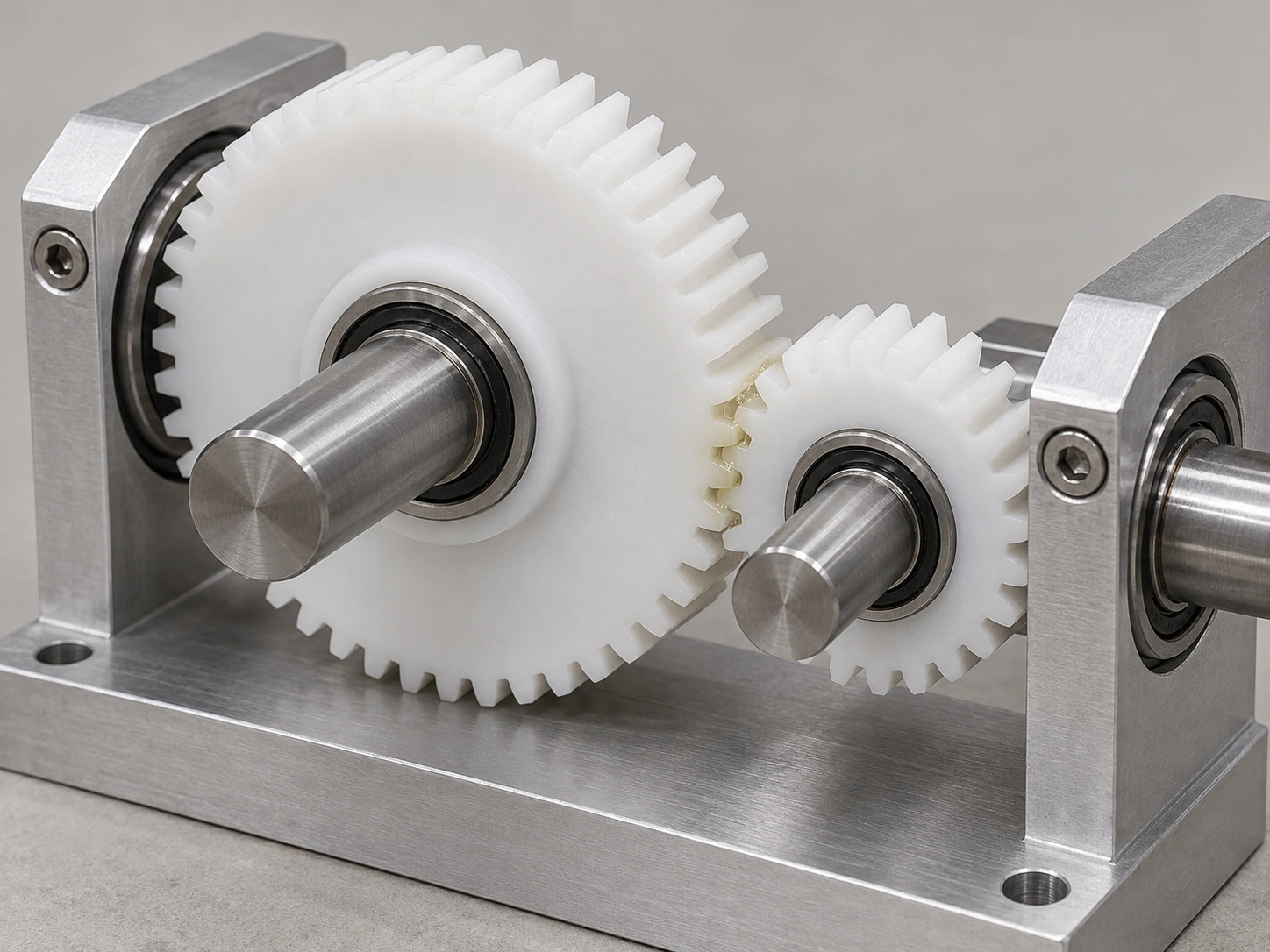
Check the actual resin grade, tooth load and noise.
Compare starting drag, squeak, dose and migration.
Review cold starts and behaviour after cycling.
SELECTION IN CONTEXT
Grease can change friction and noise at a contact. Tooth geometry, backlash, shaft alignment, assembly and wear can also be involved. Record the temperature, load and direction where noise occurs, then compare candidates on the actual polymer using both sound and operating torque.
Define the differences between contacts before comparing candidate materials.
| Contact | Selection & evaluation | Record |
|---|---|---|
| Polymer & mating material | Use the actual resin grade, including fillers, and review contact with seals or coatings; a polymer family name alone is insufficient. | Polymer grade, mating material, adjacent parts and current lubricant |
| Noise & tooth contacts | Reproduce the operating condition and compare noise, tooth condition and wear using the same method. | Direction, load, speed and sound measurement position/method |
| Cold starts | Condition the mechanism at the specified temperature and compare start-up, peak current or starting torque against the design limits. | Temperature, conditioning time, start-up procedure and current or torque |
| Dose & durability | More grease is not automatically better. Review supply to working contacts, migration and condition after cycling. | Application point/dose, cycles, oil separation, migration and wear |
Record the noise trigger and allowable torque; inspect mechanical causes too.
Compare the current and candidate materials on matching parts, cleanliness, locations and doses.
Record cold starts, normal running and post-cycle noise, torque and component condition.
Do not substitute by category name alone. Review the formulation, including base oil/additives, actual polymer and seal compatibility, load, temperature and torque.
A lubricant temperature range does not establish start-up of the assembly. Read the grade test conditions and check mechanism current, torque and motion at the required temperature.
MATERIALS & GRADES
Grease selection for small plastic gears and plastic-to-metal interfaces. Review starting torque, noise and material compatibility.
Resin and elastomer grades, starting torque, noise, migration and dose
View the product family & documentation →Confirm numerical specifications and use scope in current grade-specific TDS and SDS. Share the part drawing, materials, conditions and evaluation targets.
Technical enquiry & samples →